Productising an AI pitch tool for GTM teams
Every consultancy claims AI. We had to show it — live, in the room.

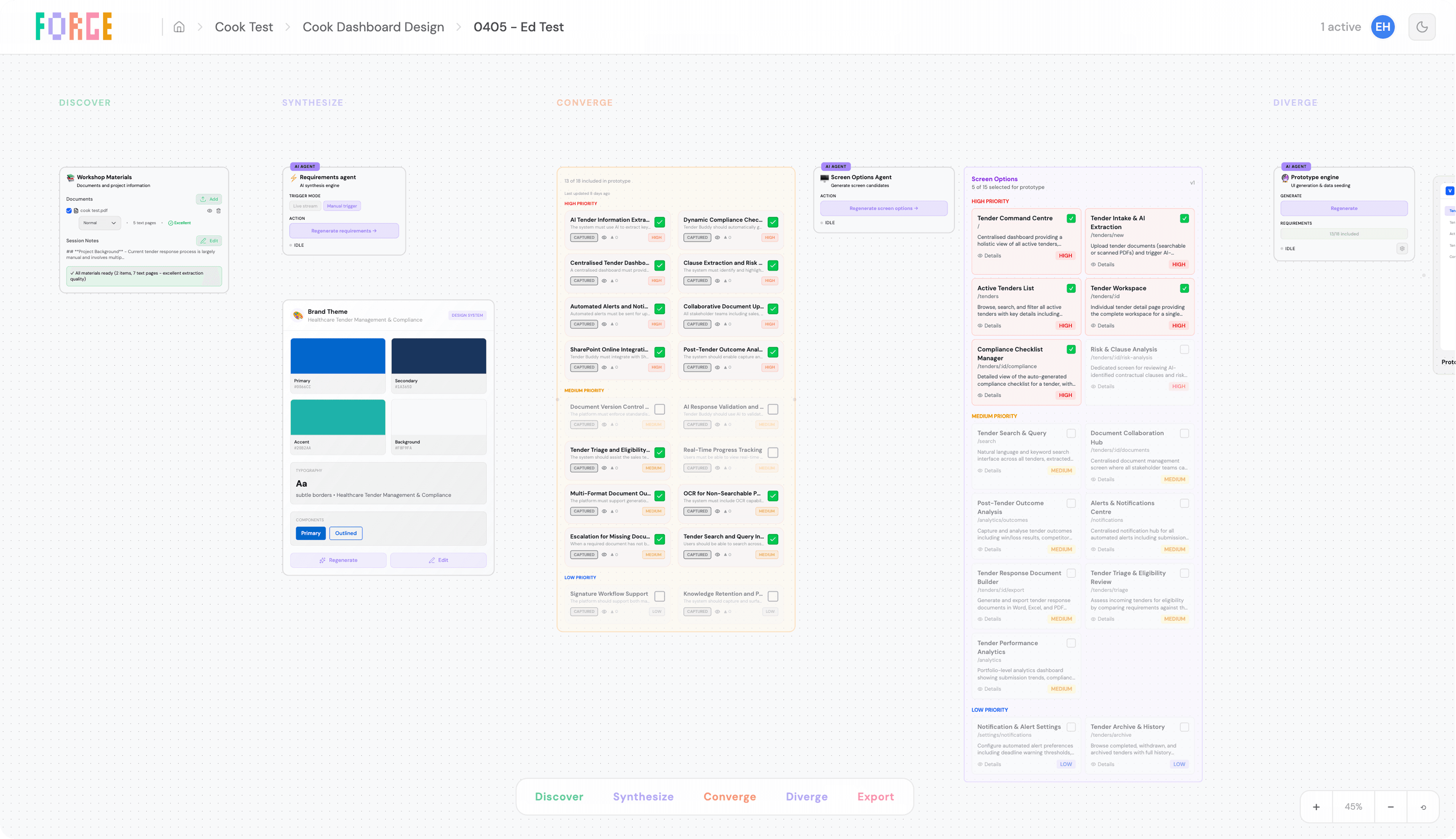
Forge is an AI concept visualisation tool. It runs client materials through a five-stage multi-agent pipeline, turning websites, transcripts, and workshop notes into structured problem statements, requirements, and design artifacts.
It was built for the moment a client first asks "can you actually do this?". It turns a pitch conversation into a working demo, in the room, using the client’s own context.
Forge is used primarily by GTM/Sales and product individuals during new client calls and pitch conversations. Subsequent rollout extends to all client-facing staff: solution architects, practice leads, senior consultants, and designers involved in discovery and delivery.
- Role
- Lead Product Designer
- Period
- 2026
- Stack
- FigmaClaude CodeCursorReactShadcn UIAWS Bedrock

Discover
Live transcription and file document analysis
Synthesize
Requirements Agent, content synthesis, ordering and prioritization. Pain-points, ideas selected
Converge
Screen options agent, generate potential screen flow options — user to select
Diverge
Prototype agent, generate UI design outputs




The problem
Forge worked as a POC but wasn’t shaped for the moment it had to perform: a client meeting where the AI’s outputs are the conversation. The flow assumed a linear path from input to UI.
It didn’t account for how GTM teams actually drive a pitch: jumping between problem framing, requirements, and visual artifacts as the room dictates. There was no scaffolding to make the AI’s reasoning legible live.
Constraint: Forge had four jobs in one surface:
- Showcase AI capability
- Guide the sales conversation
- Generate requirements
- Unlock the art of the possible
How might we reimagine Forge as a tool that can be brought into initial product conversations: framing problems, visualising solutions, and exciting clients in the first sales call?
Key Product Decisions
The decisions below shaped the product direction of Forge. Each emerged from a different pressure: what GTM users told us in interviews, what surfaced through design iteration, and what the AI engineering layer could actually support.
Canvas pattern
Non-determinismOriginal POC was a singular UI concept generation, too rigid for live calls. AI outputs are non-deterministic by nature. The same prompt rarely returns the same result, so a single fixed generation couldn’t be relied on in the room.
Proposed new design pattern: an interactive whiteboard (multi-node, free-form), referencing Flora AI and Miro. Outputs become rearrangeable artifacts on a shared surface.
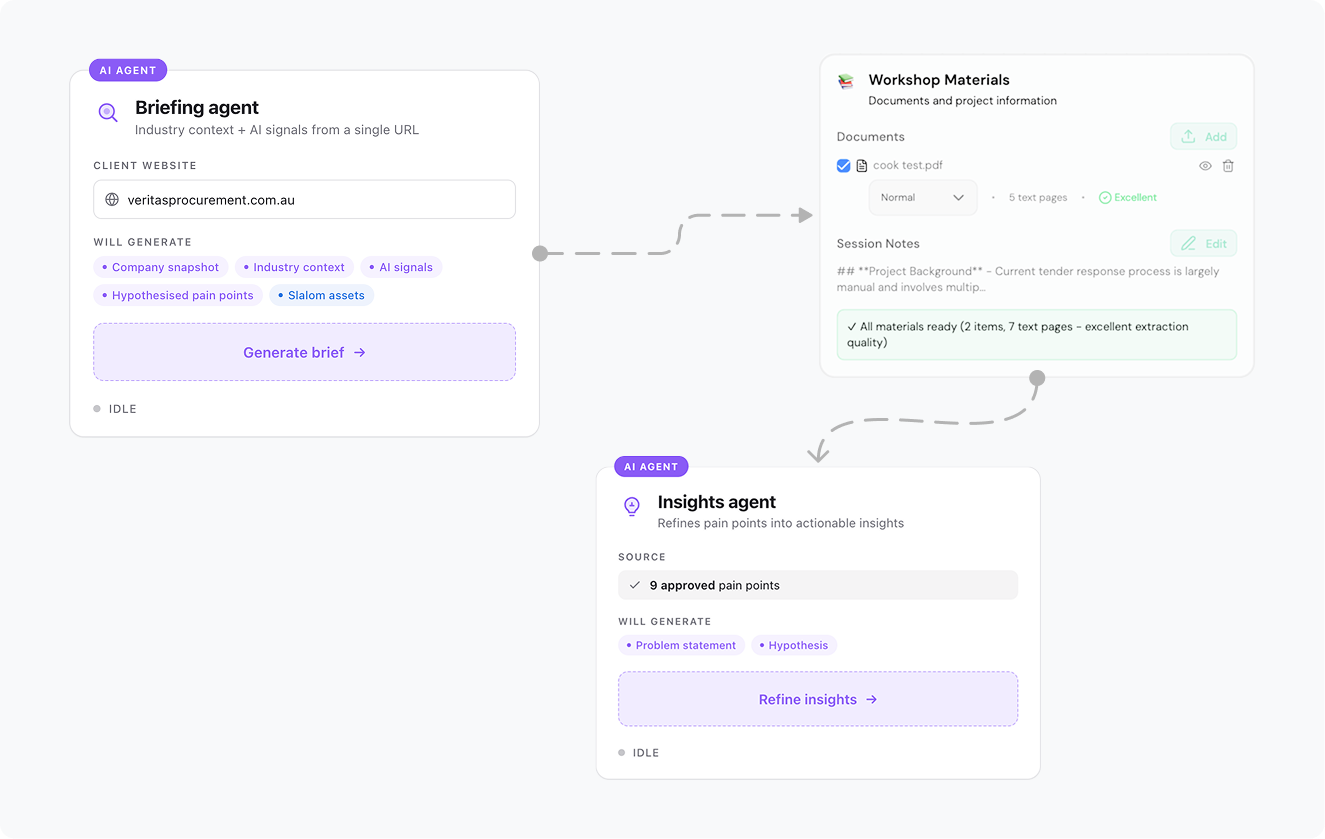
Sub-agent framing
Trust + ControlGTM users needed more control rather than jumping to ideas. It needed to be grounded in pain-points and actionable stories.
Introduced sub-agent stages that gave users explicit control at three points:
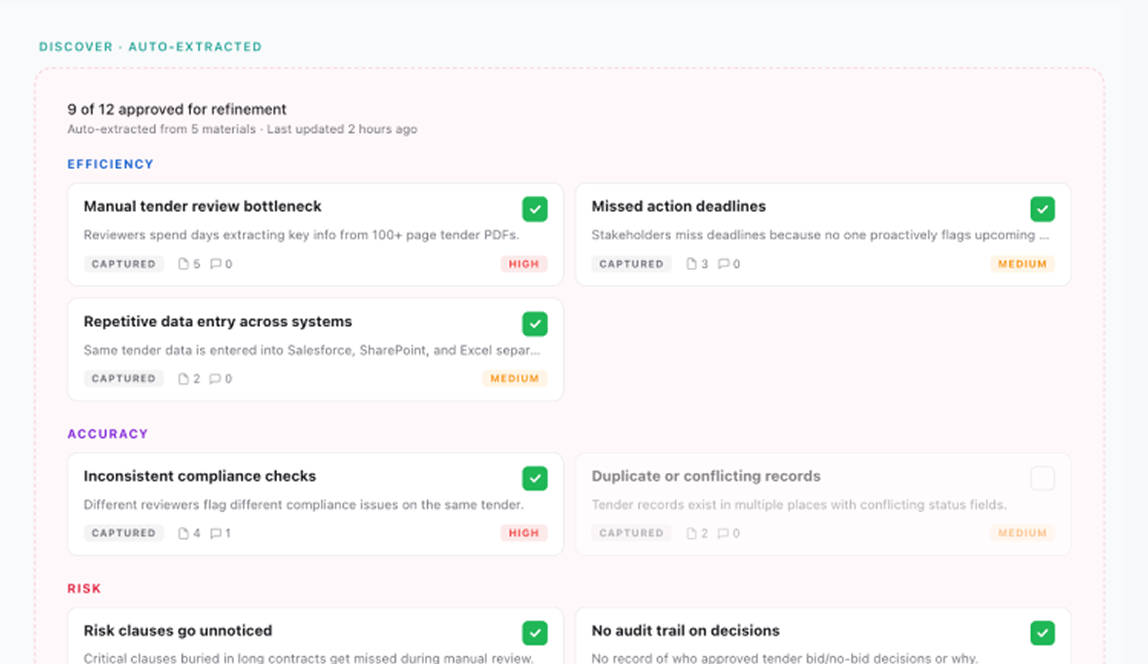
Pain point selection — users choose which surfaced problems to action, rather than the AI deciding which matter.
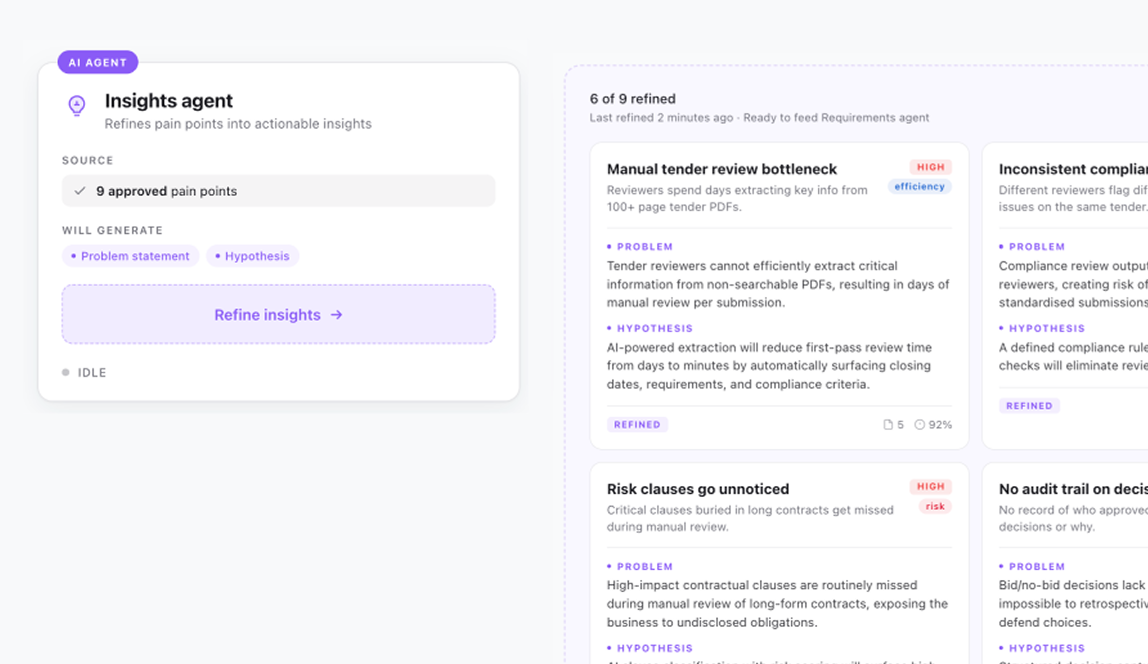
User story generation — selected pain points run into a new agent stage that produces structured user stories.
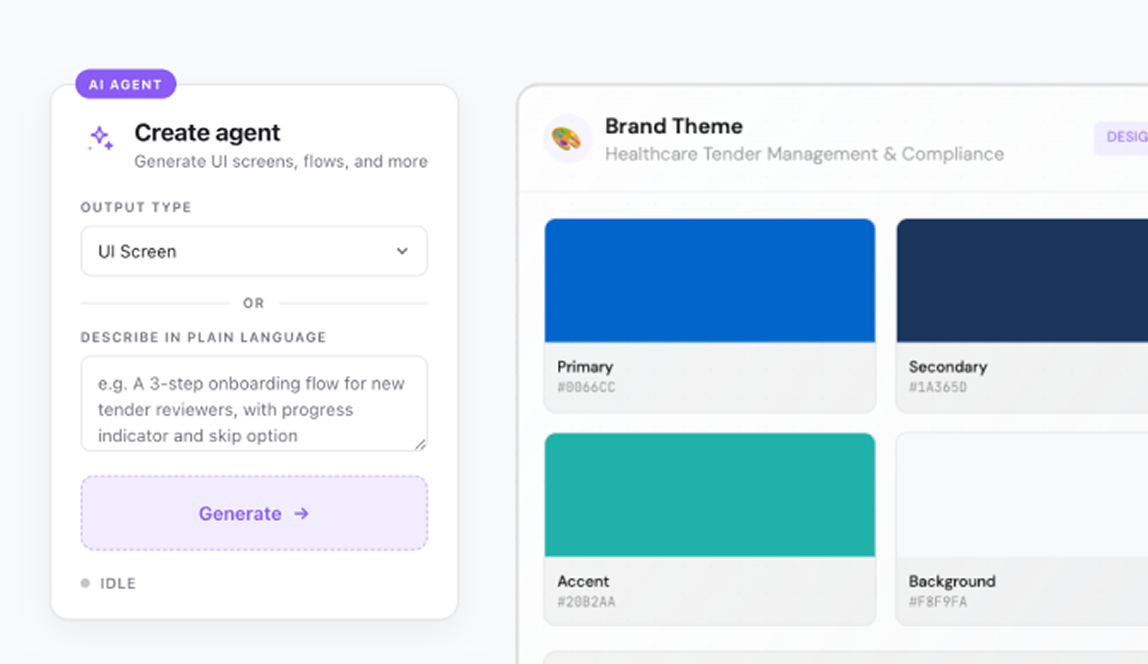
Output type selection — instead of UI-only, users choose user flows, architecture diagrams, or enter a natural-language prompt for custom output.
Context engineering
LatencyUI generation took 1–3 minutes, produced generic off-brand output, and only handled UI mockups.
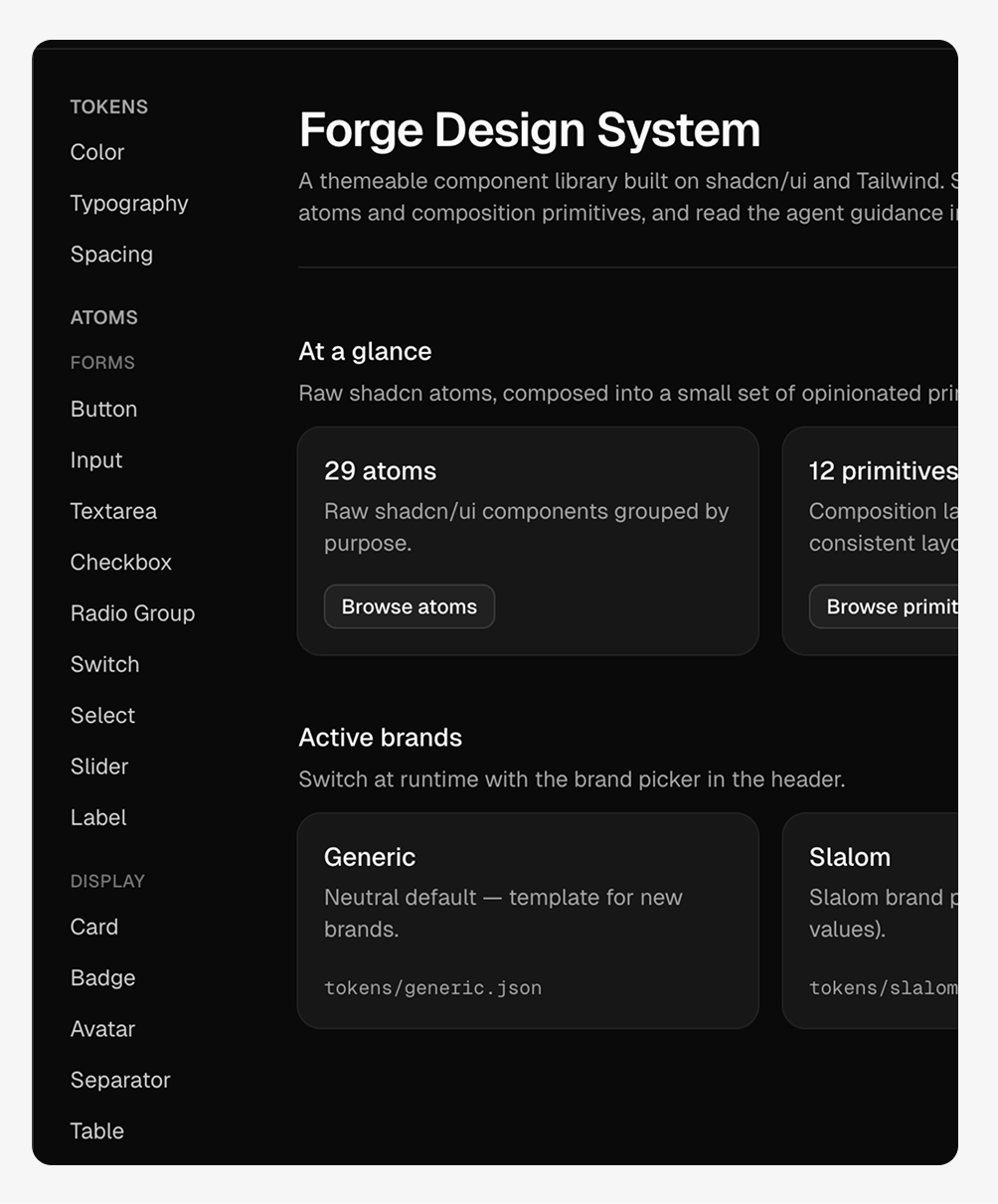
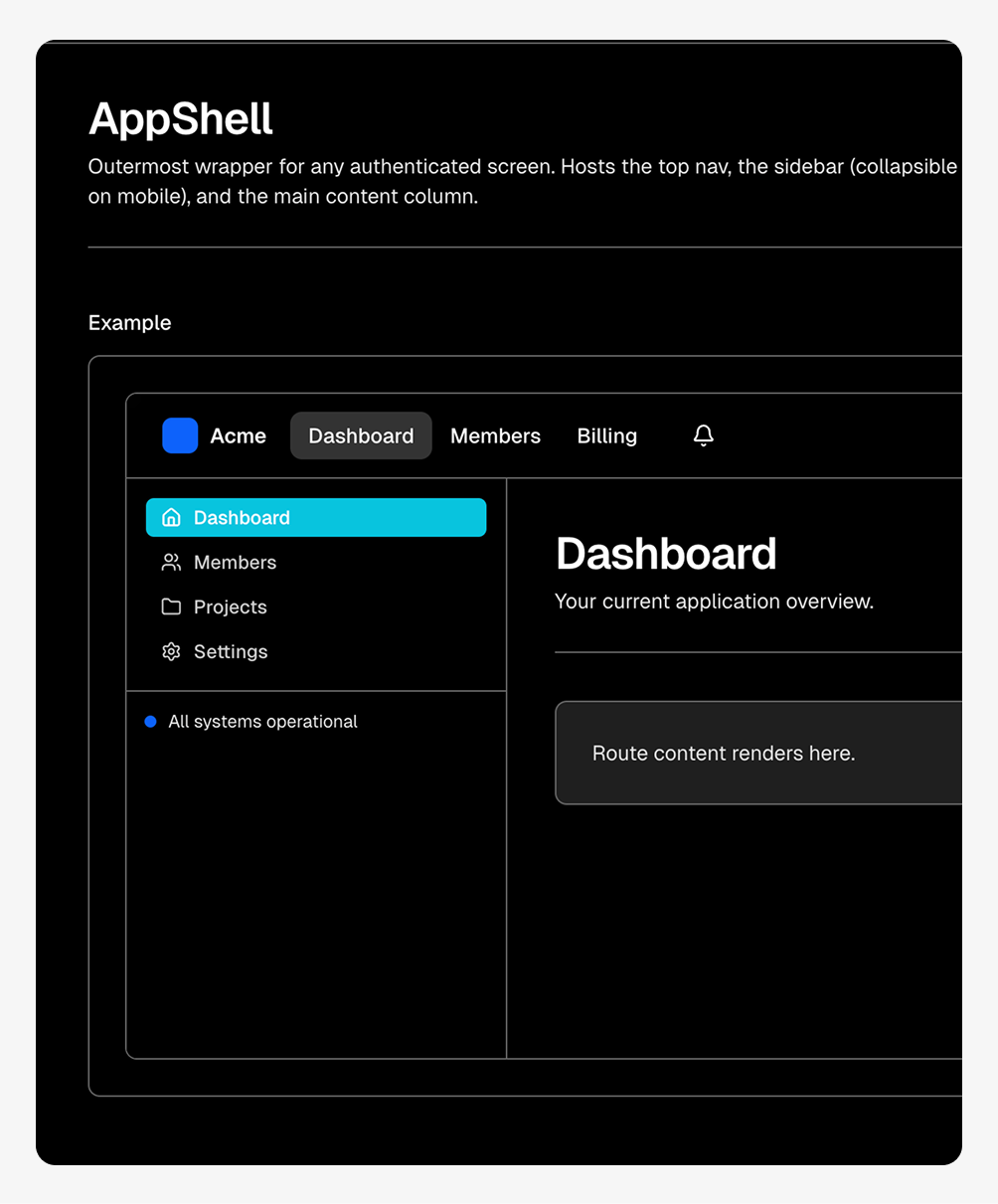
Gave the AI a reference library to build from instead of regenerating components and layouts from scratch each time:
- Atomic design component repo — components and layout options
- Mapped to semantic tokens (Slalom, Mid-fi, Custom)
- Linked to Design.md guidance and principles
AI differentiator
GroundingEvery consultancy can wrap an LLM. A generic AI tool doesn’t win pitches.
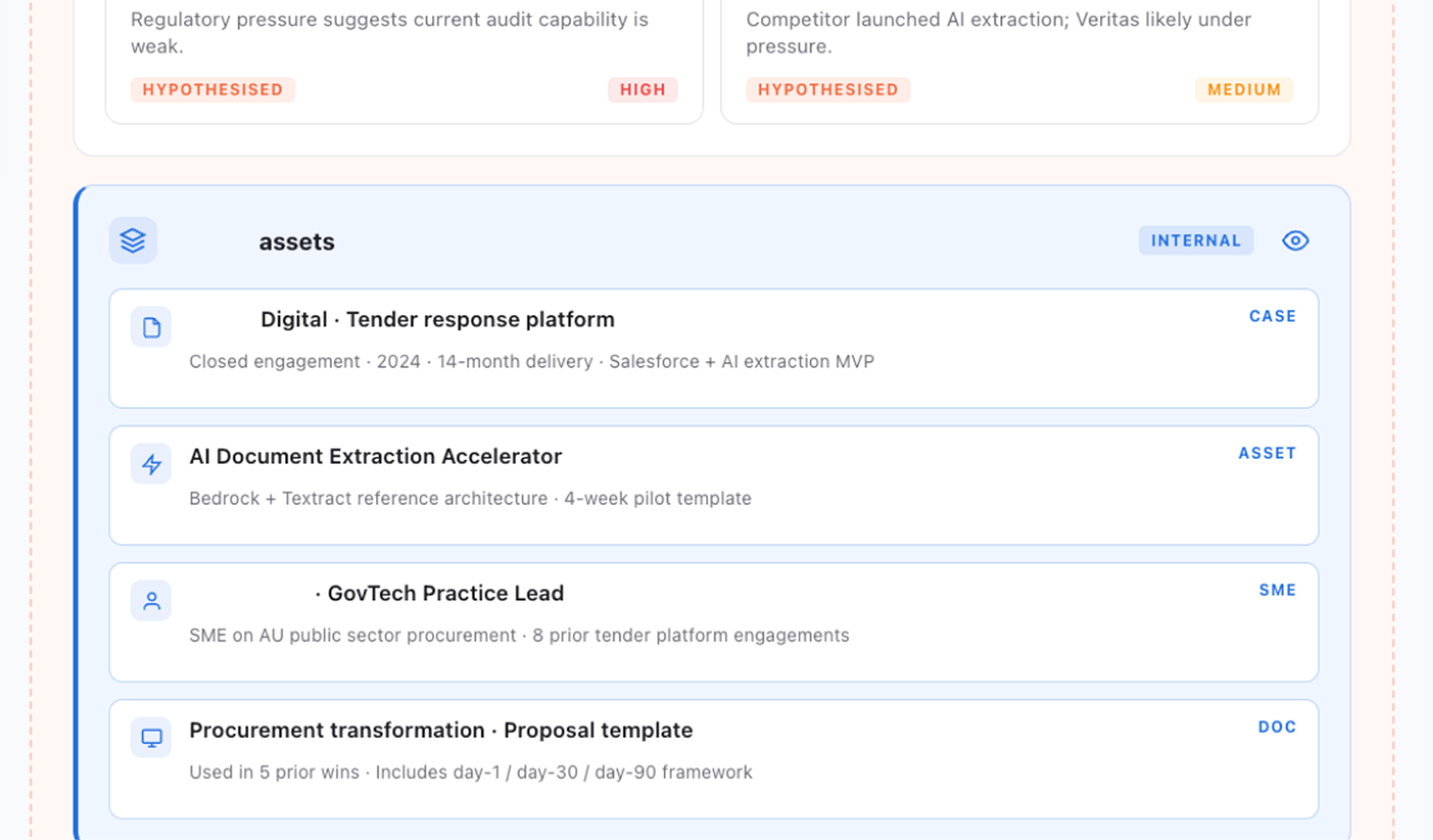
Recommended proprietary context injected at key reasoning stages: industry context from past project engagements linked to SharePoint. Outputs anchored in knowledge competitors don’t have.
Outcome
A pitch tool that performs in the room
Reframing the linear POC as a canvas let GTM teams drive a live call the way they actually run one, moving between problem framing, requirements, and visual artifacts as the conversation turns, instead of following a fixed input-to-UI path.
On-brand output, fast enough to keep momentum
The Shadcn reference library and design.md templates replaced slow, generic regeneration. Outputs now read as considered design rather than raw AI, fast enough to sustain a conversation instead of stalling it.
A differentiator competitors can’t wrap an LLM around
Proprietary context injected at key reasoning stages anchors outputs in knowledge from past engagements, turning Forge from a generic AI demo into something specific to the firm, and hard for anyone else to replicate in a pitch.